

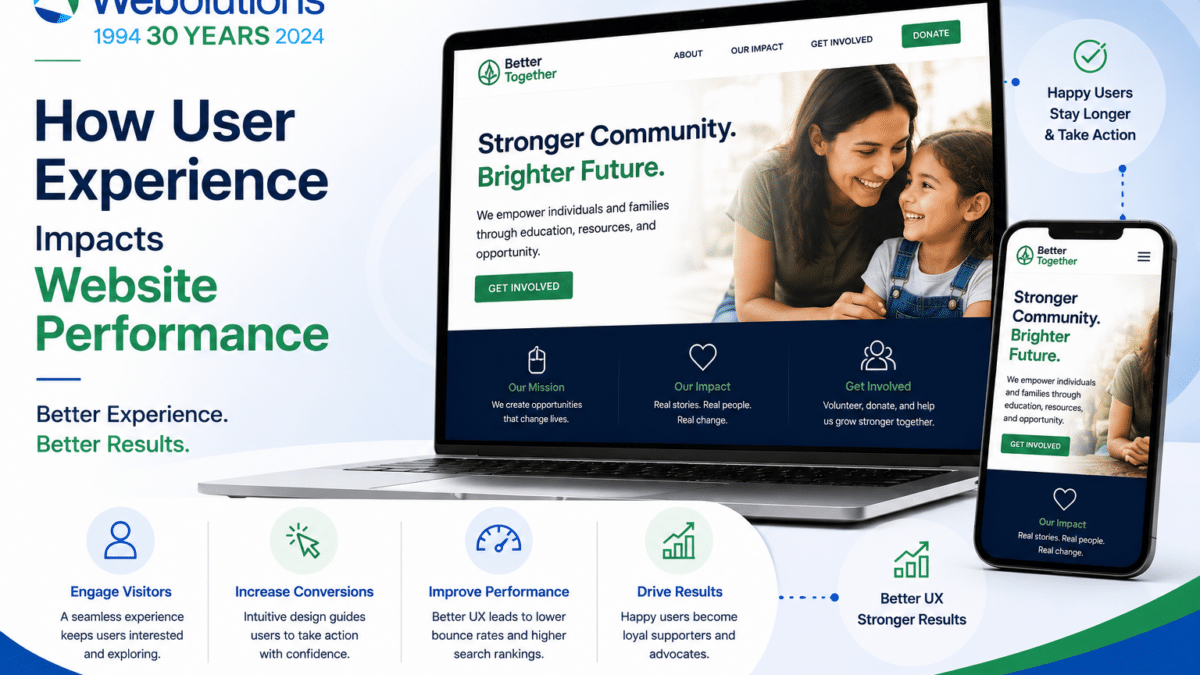
User experience directly impacts website performance by influencing how easily visitors can find information, evaluate services, and take action. Websites with clear navigation, logical structure, fast load speeds, and intuitive layouts typically generate higher engagement and conversion rates.
Through decades of work helping organizations improve digital performance, Webolutions web design and digital marketing has consistently observed that user experience is a strategic factor rather than simply a design consideration. Websites that prioritize usability and decision support generate stronger engagement, better search visibility, and more qualified leads than websites focused primarily on visual appearance.
Organizations that approach user experience strategically typically achieve more predictable marketing results over time.
Why User Experience Matters
User experience refers to how visitors interact with a website and how easy the website is to use.
For business websites, user experience influences:
-
Visitor engagement
-
Time on site
-
Conversion rates
-
Search visibility
-
Lead quality
Many businesses assume user experience is primarily a design concern.
In practice, user experience is a strategic factor that influences overall marketing performance.
Websites that support customer evaluation and decision-making help visitors move confidently toward action. Websites that create friction often lose potential customers.
User experience plays a central role in whether a website becomes a reliable source of leads.
What User Experience Really Means
User experience includes more than visual design.
It includes how easily visitors can:
-
Understand the business
-
Find relevant services
-
Navigate pages
-
Read content
-
Take the next step
Effective user experience removes unnecessary obstacles.
When visitors can move through a website efficiently, they are more likely to engage.
When obstacles exist, visitors often leave.
Webolutions designs user experience around the entire customer journey, from initial interest through confident decision-making.
User experience affects every stage of the visitor journey.
User Experience Influences First Impressions
Visitors form impressions quickly.
Within seconds of arriving on a website, visitors begin evaluating:
-
Professionalism
-
Credibility
-
Relevance
-
Ease of use
Websites that appear organized and easy to use encourage visitors to continue exploring.
Websites that appear confusing or difficult to navigate often lose visitors quickly.
Experience across many industries shows that clarity and usability strongly influence whether visitors continue exploring a website.
First impressions influence engagement.
User experience shapes those impressions.
Clear Navigation Improves Performance
Navigation is one of the most important elements of user experience.
Effective navigation helps visitors quickly locate relevant information.
Strong navigation typically:
-
Uses clear labels
-
Groups related information
-
Limits unnecessary complexity
-
Reflects customer priorities
Visitors often expect to find:
-
Services
-
Industries served
-
About information
-
Resources
-
Contact details
Navigation that matches expectations improves engagement.
Confusing navigation increases bounce rates.
Strategic website architecture ensures that visitors can move easily from initial interest toward meaningful engagement.
Page Structure Supports Decision-Making
Visitors scan pages rather than reading them line by line.
Clear page structure helps visitors process information efficiently.
Effective page structure includes:
-
Clear headings
-
Logical sections
-
Consistent formatting
-
Short paragraphs
-
Scannable content
Structured pages allow visitors to quickly identify relevant information.
Poor structure slows decision-making.
When visitors struggle to understand content, they often leave.
Webolutions’ strategy-first methodology aligns page structure with customer decision stages so visitors encounter the right information at the right time.
Readability Influences Engagement
Content that is difficult to read reduces engagement.
Readability depends on factors such as:
-
Font size
-
Line spacing
-
Contrast
-
Paragraph length
-
Layout consistency
Readable content encourages visitors to continue exploring.
Dense or poorly formatted content discourages engagement.
Readability improvements often increase time on site.
Strategic formatting supports efficient evaluation and decision-making.
Mobile Usability Is Essential
Mobile traffic represents a significant portion of website visits.
Websites that perform poorly on mobile devices often lose potential customers.
Effective mobile usability includes:
-
Responsive layouts
-
Readable text
-
Simple navigation
-
Fast load times
-
Easy-to-use forms
Mobile usability affects both engagement and search visibility.
Search engines prioritize mobile-friendly websites.
Poor mobile usability reduces performance.
Strategic mobile design ensures that visitors can move easily toward action on any device.
Website Speed Affects Behavior
Speed influences how visitors interact with a website.
Slow websites often experience:
-
Higher bounce rates
-
Lower engagement
-
Reduced conversions
Visitors expect pages to load quickly.
Delays create frustration.
Performance improvements often produce measurable gains.
Technical performance is a strategic component of user experience because it directly influences engagement and conversion rates.
Consistency Builds Confidence
Consistency improves usability.
Consistent websites use:
-
Similar layouts
-
Consistent navigation
-
Repeating design patterns
-
Predictable page structures
Consistency helps visitors learn how the website works.
Predictability reduces confusion.
Confidence improves engagement.
Consistency strengthens both usability and credibility.
User Experience Influences Conversion Rates
Conversion performance depends on how easily visitors can take action.
Effective user experience supports conversion by:
-
Reducing friction
-
Providing clear pathways
-
Simplifying forms
-
Providing clear instructions
-
Making calls-to-action visible
Even strong messaging can underperform if user experience creates obstacles.
Strategically designed conversion pathways help visitors move naturally from interest to engagement.
Improved usability often increases conversion rates.
User Experience Influences Search Visibility
Search engines evaluate user experience signals.
These signals include:
-
Time on site
-
Engagement
-
Bounce rates
-
Mobile usability
-
Page speed
Positive user experience signals often support stronger rankings.
Websites that frustrate visitors often struggle to maintain visibility.
User experience supports long-term search performance.
Websites that combine strong usability with strategic content typically achieve more stable search visibility.
Closing Insight
User experience plays a central role in website performance by influencing engagement, search visibility, and conversion rates.
Websites that are easy to use help visitors evaluate services and move confidently toward decisions.
Webolutions approaches user experience as a strategic discipline that connects customer needs with business growth. When navigation, structure, readability, and performance align, a website becomes a reliable platform for sustainable lead generation and long-term growth.

Drawing from experience in web design, SEO, and digital marketing strategy, these articles are designed to help business leaders move beyond fragmented tactics and toward a more structured, performance-driven approach to digital marketing.Vargo was awarded 2019 Top SEO Consultants in the U.S..Learn more about John Vargo.
- Conversion-Focused Website Design Strategies - July 29, 2026
- Case Study: How a Denver Contractor Increased Qualified Leads by 300% - July 28, 2026
- SEO-Friendly Website Design: What Businesses Should Know - July 24, 2026