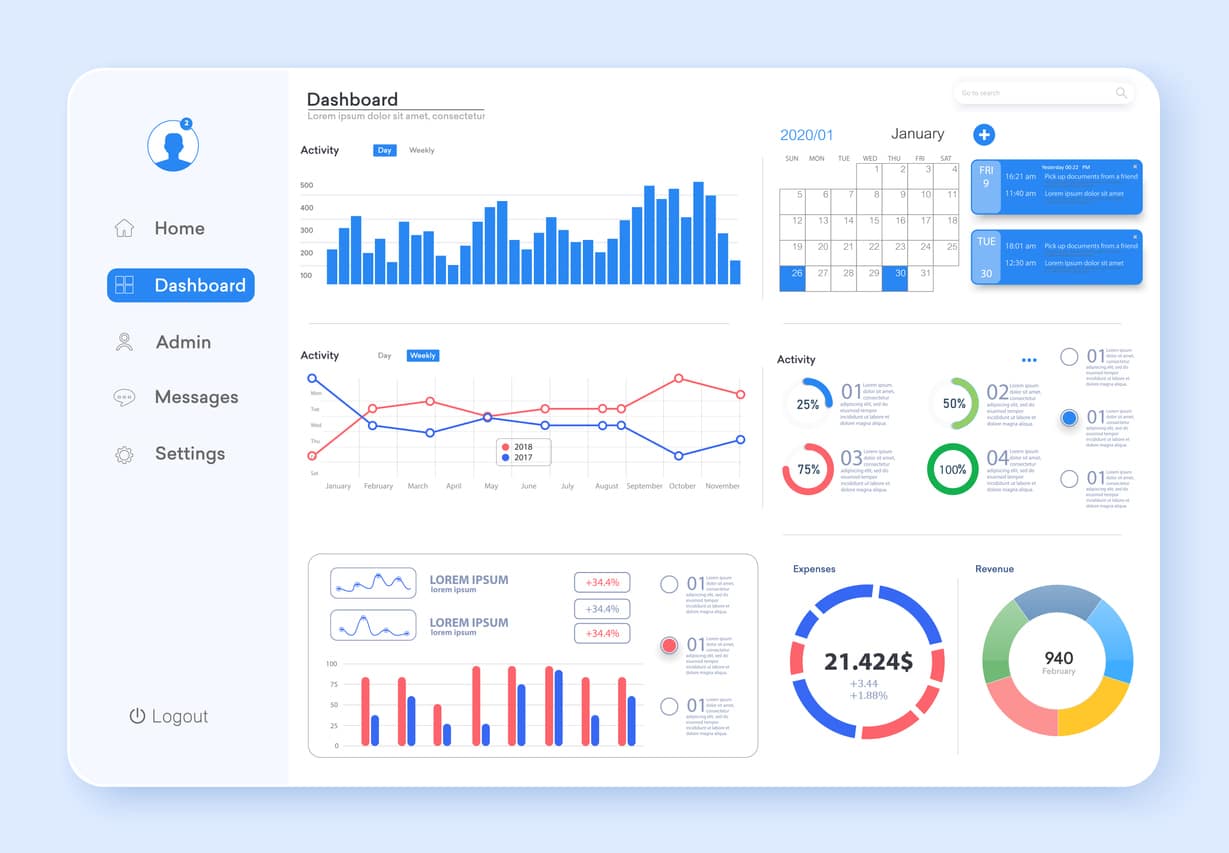

The modern Chief Marketing Officer sits at the crossroads of creativity and accountability. Every campaign, touchpoint, and interaction produces an avalanche of data—but not all data leads to insight. In an era defined by automation, attribution, and artificial intelligence, the greatest challenge for CMOs is not collecting information, but clarifying meaning. The marketing dashboard has become the instrument panel of that mission: a single, dynamic environment where performance, perception, and purpose converge.
In the hands of a skilled CMO, a well-structured dashboard becomes far more than a reporting tool. It is a decision engine—a system that transforms complexity into confidence. According to MIT Sloan Management Review, 73% of marketing executives say they are “data-rich but insight-poor,” highlighting the widening gap between measurement and meaning (https://sloanreview.mit.edu/article/the-human-side-of-digital-transformation/). This gap persists because most dashboards are built to display data, not to drive understanding. The goal of modern marketing intelligence is therefore not visibility, but vision: aligning metrics with the narratives that move organizations forward.
The most effective dashboards bridge three domains: behavioral science, which shapes how humans interpret data; user experience design, which determines how insight flows through visual space; and organizational strategy, which defines how insights influence action. As Deloitte Digital notes, high-performing CMOs are now “experience orchestrators,” not just data interpreters—leaders who ensure that dashboards serve as collaborative ecosystems for alignment, not silos of numbers (https://www.deloittedigital.com/us/en/insights.html).
Behavioral psychology offers valuable context here. Studies from the Stanford Persuasive Technology Lab and The Decision Lab reveal that clarity and confidence in decision-making increase when data is presented through intuitive visual frameworks that reduce cognitive load (https://behaviormodel.org; https://thedecisionlab.com). In other words, design shapes belief. When dashboards present metrics as meaningful stories—connecting ROI to purpose, conversion to customer experience—they don’t just inform decisions; they inspire them.
Moreover, the next generation of marketing dashboards integrates real-time AI analytics and predictive modeling to forecast trends, not just report history. The Salesforce State of Marketing Report found that 60% of leading marketers now use predictive dashboards to inform cross-departmental strategy (https://www.salesforce.com/resources/research-reports/state-of-marketing/). This evolution transforms dashboards into shared intelligence systems—interfaces where marketing, sales, and leadership collaborate on a single source of experiential truth.
For Webolutions, marketing dashboards represent more than data visualization—they are strategic alignment tools. They embody the agency’s mission to connect analytics with empathy, transforming fragmented insights into a unified understanding of growth. By fusing behavioral insight, design clarity, and ethical intelligence, dashboards become not just monitors of performance but architectures of foresight—guiding CMOs toward smarter, faster, and more confident decisions.
Strategic Takeaway
The modern dashboard is a reflection of marketing maturity. For Webolutions, its purpose extends beyond measurement—it’s about creating decision intelligence. By uniting behavioral science, UX design, and real-time analytics, dashboards evolve from static screens into strategic control systems that empower CMOs to lead with both data and discernment. The future of marketing leadership belongs to those who don’t just see data—but understand its story.
The Evolution of the Marketing Dashboard
The marketing dashboard has undergone a remarkable transformation. What began as a static spreadsheet of campaign metrics has evolved into a real-time strategic command center—a dynamic interface that enables CMOs to navigate complexity with clarity. This evolution reflects a larger shift in marketing itself: from reactive reporting to experience orchestration, where data not only describes performance but directs it.
From Reporting to Intelligence
Early dashboards were retrospective tools. They answered the question, “What happened?” Today’s dashboards answer a far more sophisticated one: “What’s happening, why, and what should we do next?” This shift represents the rise of decision intelligence, the ability to connect descriptive, diagnostic, and predictive analytics in one integrated environment. According to Google Marketing Platform, organizations that employ real-time analytics dashboards are 1.7x more likely to exceed their revenue goals than those using periodic reports (https://marketingplatform.google.com/about/analytics/).
The Salesforce State of Marketing Report reinforces this evolution, noting that 78% of marketing leaders now view dashboards as alignment tools—platforms that synchronize marketing, sales, and service around a unified performance narrative (https://www.salesforce.com/resources/research-reports/state-of-marketing/). Dashboards have become the organizational “language of truth,” a medium where metrics transform into shared meaning across departments.
Integration and the Rise of Connected Intelligence
The modern marketing ecosystem runs on integration. Dashboards now aggregate inputs from CRM systems, social platforms, paid media, and customer data platforms (CDPs), creating an omnichannel view of performance. This level of cohesion transforms isolated metrics—clicks, leads, impressions—into relational insights that reveal how customer journeys unfold across touchpoints. MIT Sloan Management Review calls this “connected intelligence,” the practice of using unified analytics to align experience delivery with business outcomes (https://sloanreview.mit.edu/article/the-human-side-of-digital-transformation/).
When structured properly, a dashboard does not simply collect KPIs; it contextualizes them. For example, a surge in web traffic means little without insight into its source, audience intent, or conversion path. By integrating data pipelines through platforms like HubSpot, Google Data Studio, and Tableau, CMOs gain a holistic perspective that moves beyond reporting into orchestration—turning dashboards into decision ecosystems.
From Metrics to Meaning
The most progressive CMOs treat dashboards as narrative environments. Rather than overwhelming users with raw numbers, they design visualizations that tell a story—of cause, effect, and opportunity. This approach is supported by behavioral science. Research from The Decision Lab shows that when data is organized around story structures—setup, insight, and action—executives are 2.8x more likely to interpret information accurately and act upon it (https://thedecisionlab.com).
For Webolutions, this narrative approach is central to dashboard strategy. The goal is not to measure more, but to measure meaningfully. By connecting performance data to brand purpose and customer experience, dashboards become instruments of focus—helping CMOs see what matters, ignore what doesn’t, and act with confidence in an age of information overload.
Strategic Takeaway
The evolution of the marketing dashboard mirrors the evolution of marketing leadership itself—from analysts of the past to architects of the future. For Webolutions, dashboards are no longer static scorecards but living intelligence systems. They empower CMOs to translate complexity into clarity, align teams around purpose, and steer their organizations with precision. In this new paradigm, dashboards don’t just track performance—they create direction.
Behavioral Science Behind Data Interpretation
Every marketing dashboard tells a story—but how that story is perceived depends on human psychology. The most advanced analytics systems still serve human decision-makers, and those humans are not perfectly rational. They filter information through emotion, bias, and cognitive shortcuts. For CMOs, understanding the behavioral science behind data interpretation is crucial. The best dashboards aren’t just well-designed—they’re psychologically attuned to how executives absorb complexity and form confidence.
Why Data Alone Doesn’t Drive Decisions
Information overload is the modern CMO’s silent barrier. Research from the Stanford Persuasive Technology Lab shows that when people encounter too much unstructured data, motivation to act drops significantly—a phenomenon known as decision fatigue (https://behaviormodel.org). Dashboards designed without behavioral insight often create the illusion of control while actually amplifying uncertainty. To overcome this, decision systems must prioritize clarity over quantity and actionability over accumulation.
Behavioral economists call this the paradox of choice: more options, more metrics, and more charts often lead to less decision-making. The Decision Lab reports that simplifying dashboards around key behavioral triggers—such as goal progress, deviation alerts, and contextual storytelling—can increase executive engagement by up to 42% (https://thedecisionlab.com). Dashboards should function like well-crafted narratives: focusing attention where it matters most and minimizing cognitive friction.
The Psychology of Visual Trust
Perception of accuracy is often emotional, not analytical. Studies from the American Psychological Association (APA) show that people judge visualized data not just by its content, but by its aesthetic credibility—clean layouts, symmetry, and consistent labeling all subconsciously signal reliability (https://www.apa.org). When dashboards reflect design integrity, they strengthen perceived organizational integrity. In B2B environments where trust drives multi-million-dollar decisions, such design cues can profoundly influence confidence in strategy.
Dashboards also trigger the anchoring effect, a cognitive bias in which initial metrics disproportionately shape interpretation. If the first KPI shown highlights a shortfall—say, declining engagement—it can frame all subsequent data as negative. A well-structured dashboard mitigates this by sequencing insights to move from neutral metrics (like reach or activity) to interpretive ones (like ROI or brand sentiment). This order aligns with how the brain processes information—from recognition to reasoning to resolution.
Cognitive Fluency and “Ease of Truth”
Cognitive fluency—the ease with which information is processed—plays a critical role in how data is trusted and remembered. Behavioral Scientist magazine explains that people equate clarity with truth: data that’s easier to read and interpret feels more credible, regardless of complexity (https://behavioralscientist.org). Dashboards designed for fluency use consistent color coding, visual hierarchy, and narrative framing to help executives recognize patterns without mental strain.
Moreover, dashboard interactivity can support confidence calibration—helping CMOs test assumptions and explore alternative scenarios. When users can manipulate filters or toggle visual views, they engage in what Stanford’s Fogg Model calls ability reinforcement—increasing perceived control and therefore the likelihood of follow-through. This design principle converts dashboards from passive displays into decision participation tools.
The Emotional Arc of Data
Even in corporate environments, data is emotional. Progress bars, performance trends, and benchmarks trigger dopamine-driven feedback loops similar to those used in behavioral design for habit formation. The Decision Lab notes that small, consistent visual cues—like goal completion or color-coded progress—reinforce engagement and sustain attention far longer than static charts. Dashboards designed with these micro-feedback principles don’t just inform executives; they motivate them to act.
For Webolutions, this fusion of psychology and analytics is central to high-performing marketing systems. Every dashboard the agency designs is built to think like its user—minimizing overload, clarifying meaning, and reinforcing confidence. Data without empathy creates paralysis; data with behavioral design creates momentum.
Strategic Takeaway
Dashboards succeed when they reflect how humans actually think. For Webolutions, this means translating behavioral science into visual intelligence—using simplicity, sequencing, and design integrity to build dashboards that inspire confidence instead of confusion. When data is structured around human psychology, CMOs move from reacting to numbers to leading with insight, turning information into impact.
Core Metrics That Matter for CMOs
In the age of analytics abundance, it’s easy for dashboards to become cluttered with data that feels impressive but drives little action. The best marketing dashboards don’t show everything—they show what matters most. For Chief Marketing Officers, the goal isn’t to collect metrics but to orchestrate insight: aligning performance indicators with business outcomes, customer experience, and brand strategy. In this sense, metrics are not measurements—they’re management tools.
From Vanity Metrics to Value Metrics
Many dashboards still prioritize what’s easiest to measure—impressions, clicks, followers—rather than what’s most valuable to the organization. These vanity metrics may create a sense of momentum, but they often obscure real progress. As Deloitte Digital emphasizes, “effective marketing intelligence starts where volume ends—at the intersection of engagement quality and revenue growth” (https://www.deloittedigital.com/us/en/insights.html).
The CMOs who lead through data focus on value metrics: indicators that connect marketing to tangible outcomes. Examples include customer acquisition cost (CAC), lifetime value (LTV), retention rate, and conversion quality. These metrics reveal not only how campaigns perform but how efficiently marketing drives sustainable growth. Dashboards designed around value metrics answer the most important C-suite question: “How does marketing move the business?”
Experience Metrics: Measuring Human Impact
Beyond financial performance, CMOs are increasingly accountable for customer experience metrics that quantify how marketing feels, not just how it performs. According to Accenture Interactive’s Experience Index, 89% of executives now view experience performance—measured through satisfaction, journey friction, and emotional resonance—as a leading indicator of brand health (https://www.accenture.com/us-en/insights/interactive/experience-index).
Experience-driven dashboards integrate traditional KPIs with behavioral and perceptual data such as Net Promoter Score (NPS), Customer Effort Score (CES), and Sentiment Index. These human metrics reflect the “why” behind the “what”—explaining not only what’s happening in the data, but why customers behave the way they do. In B2B marketing, where long-term relationships are crucial, these indicators help CMOs align performance optimization with empathy-driven brand design.
Operational Alignment Metrics
For dashboards to drive real business decisions, they must also bridge marketing with operations, finance, and sales. Metrics like marketing contribution to revenue, pipeline velocity, and sales cycle length reveal how effectively marketing initiatives integrate into the broader business engine. Gartner’s 2024 CMO Leadership Study reports that CMOs who align their dashboards to cross-functional metrics are 2.4x more likely to achieve revenue targets (https://www.gartner.com/en/marketing).
By presenting unified metrics across departments, dashboards foster what Webolutions calls “organizational coherence”—a shared understanding of performance that breaks down silos. When finance, sales, and marketing all read from the same dashboard narrative, alignment happens not by meeting, but by design.
Predictive and Leading Indicators
Traditional dashboards report what has already happened; strategic dashboards forecast what comes next. Leading indicators—like engagement momentum, share of voice, and pipeline health—allow CMOs to anticipate shifts before they become problems. Predictive analytics tools, powered by AI, now enable dynamic modeling of campaign outcomes based on current trends.
The Bain & Company Marketing Analytics Report found that organizations using predictive dashboards see 18% faster response times to market changes and 22% higher budget efficiency (https://www.bain.com/insights/marketing-analytics). These predictive metrics empower CMOs to act proactively, guiding teams with foresight instead of hindsight.
The Webolutions Metric Mapping Framework
At Webolutions, every dashboard engagement begins with a Metric Mapping Workshop, where teams align performance indicators to strategic objectives, behavioral outcomes, and customer value drivers. This framework ensures that metrics reflect not only ROI but also Experience ROI (XROI)—the measurable impact of marketing on human perception, trust, and emotional engagement.
Through this approach, Webolutions helps CMOs define dashboards that don’t just track numbers—they reveal narratives of growth. Whether the objective is improving brand sentiment, increasing qualified leads, or optimizing cross-channel efficiency, every metric is chosen to reinforce purpose and decision clarity.
Strategic Takeaway
The most effective marketing dashboards are not data warehouses—they’re decision instruments. For Webolutions, the goal is to align every metric with meaning, every KPI with purpose, and every insight with action. When CMOs focus on value, experience, and predictive metrics, dashboards become tools of foresight—empowering leaders to guide strategy with evidence, empathy, and precision.
Designing for Human Decision-Makers: UX in Dashboards
A marketing dashboard is only as powerful as its usability. Data does not persuade on its own—it persuades when it is understood, trusted, and acted upon. That transformation depends on design. For Chief Marketing Officers, the difference between an insightful dashboard and an ignored one often comes down to user experience (UX). Dashboards designed for humans, not just analysts, bridge the gap between information and intuition. They guide executives toward clarity by shaping not only what data is presented, but how it is perceived.
The UX Principles That Drive Clarity
The Nielsen Norman Group defines good UX as “the quality of interaction that makes complex systems feel simple” (https://www.nngroup.com/articles/ux-principles/). In the context of dashboards, simplicity is not minimalism—it’s intentional hierarchy. Each chart, table, or color cue must serve a single purpose: helping users find meaning without friction. Dashboards that overload users with unprioritized visuals create cognitive drag, slowing comprehension and increasing decision fatigue.
Instead, UX-centered dashboards employ clear navigation, visual grouping, and progressive disclosure—revealing complexity only when needed. The result is a visual conversation rather than a static report. As the Interaction Design Foundation explains, “users don’t read dashboards; they scan for meaning” (https://www.interaction-design.org/literature/topics/data-visualization). Effective layouts anticipate this scanning behavior, using contrast, spacing, and motion to guide attention toward what matters most.
Cognitive Load and the Architecture of Understanding
CMOs operate in high-stakes, high-speed environments where cognitive bandwidth is limited. Research from Smashing Magazine highlights that decision-makers experience up to 30% higher retention rates when data is visualized with clear color coding and consistent patterns (https://www.smashingmagazine.com). This is due to cognitive offloading—the brain’s ability to delegate pattern recognition to visual cues. Dashboards that reduce cognitive load don’t just display performance; they accelerate understanding.
For example, Webolutions’ dashboard designs often separate data into strategic layers:
- Performance Layer (real-time KPIs and alerts)
- Insight Layer (diagnostic analysis and causation)
- Action Layer (recommendations or next-step triggers)
This tiered approach mirrors how humans process information: first identifying signals, then seeking context, then deciding on response.
Designing for Emotion and Trust
Visual design also carries emotional weight. According to Adobe Digital Trends (https://business.adobe.com/resources/digital-trends.html), users perceive aesthetically pleasing dashboards as more credible, even when data accuracy is identical. This is the aesthetic–usability effect: the phenomenon where visually harmonious design increases tolerance for minor errors and strengthens trust. Color psychology further reinforces this—greens and blues signal stability and control, while red accent tones drive attention to urgency or opportunity.
For CMOs, this matters deeply. When dashboards convey emotional balance—through intuitive color use, proportional spacing, and uncluttered typography—they produce a sense of mastery rather than overwhelm. That sense of mastery fuels confidence, which fuels decision velocity.
Accessibility and Inclusivity in Data Design
Accessibility is both a UX and ethical priority. Dashboards should be designed for diverse cognitive and physical capabilities, ensuring every leader can engage equally with insight. UX Planet emphasizes that accessibility is not a compliance checkbox—it’s a trust amplifier (https://uxplanet.org). Including readable fonts, colorblind-safe palettes, and voice-assisted navigation expands usability and demonstrates brand integrity. For CMOs managing distributed or hybrid teams, accessible dashboards democratize data-driven decision-making.
The Role of Iteration and Feedback
Great UX is iterative. Dashboards are not static deliverables but evolving systems that must adapt to user feedback and changing organizational needs. Regular usability testing, combined with heatmaps or interaction analytics, reveals how executives actually use dashboards versus how they’re intended to. This approach reflects Webolutions’ philosophy of continuous experience refinement—the practice of optimizing systems not around perfection, but around human behavior in motion.
For Webolutions, UX design in dashboards is the bridge between technology and trust. Every interaction, from mouse movement to color transition, is an opportunity to reinforce clarity, competence, and care.
Strategic Takeaway
Dashboards succeed not when they display the most data, but when they design the clearest path to understanding. For Webolutions, human-centered dashboard UX means aligning data presentation with decision psychology—balancing clarity, emotion, and accessibility. When dashboards are crafted for how people see, think, and feel, they cease to be analytics tools and become leadership instruments—interfaces that empower CMOs to act with intelligence and intuition in equal measure.
Integrating AI and Predictive Analytics
Artificial intelligence is redefining what a marketing dashboard can be. Once limited to static performance summaries, dashboards are now evolving into predictive decision ecosystems—systems that anticipate opportunities, detect anomalies, and surface insights before humans even know to ask for them. For CMOs, this transformation represents both a technological and strategic inflection point. The goal is no longer just to visualize what’s happened, but to forecast what will—and more importantly, why.
From Descriptive to Predictive Decision Intelligence
Traditional dashboards answered “what happened?” Predictive dashboards answer “what happens next?” By integrating machine learning algorithms, dashboards can now analyze historical data to model probable outcomes across campaigns, channels, and customer segments. The MIT Technology Review calls this “decision augmentation”—the fusion of human intuition with machine precision (https://www.technologyreview.com).
Predictive dashboards leverage supervised and unsupervised learning to identify behavioral patterns invisible to human analysts. For instance, they can detect correlations between engagement velocity and brand advocacy or forecast churn risk based on declining micro-interactions. These capabilities help CMOs shift from reactive performance review to proactive opportunity orchestration.
Google AI Blog underscores this trend, noting that AI-enabled dashboards can reduce marketing decision latency by up to 40% through real-time anomaly detection and automated recommendations (https://ai.googleblog.com). For enterprise-level CMOs, where time-to-decision equals competitive advantage, that acceleration is transformative.
AI as a Strategic Collaborator
Integrating AI into dashboards changes the relationship between marketers and data. Rather than merely reporting insights, AI systems become strategic collaborators, continuously refining assumptions and optimizing performance. Predictive engines can simulate campaign outcomes, recommend budget reallocations, and highlight emerging audience segments—all in real time.
This capability extends beyond numbers. AI-driven natural language generation (NLG) tools can translate data trends into narrative summaries, enabling CMOs to understand complex analytics without decoding charts. PwC’s AI Business Survey reports that 67% of CMOs believe AI-enhanced dashboards will soon serve as “executive copilots,” providing adaptive recommendations based on company objectives (https://www.pwc.com/gx/en/issues/analytics.html).
Ethical AI: The Trust Imperative
The more intelligence dashboards acquire, the more accountability they demand. Predictive analytics introduces risks of algorithmic bias and overconfidence in machine-generated insights. The Future Today Institute cautions that AI systems trained on unbalanced or opaque data may reinforce blind spots rather than eliminate them (https://futuretodayinstitute.com/reports/).
For CMOs, ethical AI integration requires three safeguards:
- Transparency — Documenting data sources, modeling logic, and decision rationale.
- Oversight — Ensuring human review and contextual judgment remain central to interpretation.
- Alignment — Designing algorithms to support company purpose, not just performance.
At Webolutions, AI integration is grounded in the principle of “empathetic automation”—technology that enhances human insight rather than replacing it. Predictive dashboards are designed to empower decision-makers with foresight while preserving human discernment as the ultimate filter of truth.
From Analytics to Anticipation
The true power of predictive dashboards lies in anticipation. Instead of waiting for reports to confirm success or failure, CMOs can identify trends and adjust in motion. For example, real-time sentiment analysis can trigger early messaging pivots; predictive lead scoring can prioritize sales outreach; and machine learning-driven budget allocation can optimize ROI mid-campaign.
These use cases reflect a broader transformation: dashboards are becoming living systems, continuously learning, adapting, and guiding. Salesforce’s State of Marketing Report notes that predictive analytics adoption among top-performing marketing organizations has risen 92% since 2020, a signal that intelligence-led orchestration is quickly becoming the norm (https://www.salesforce.com/resources/research-reports/state-of-marketing/).
Strategic Takeaway
AI doesn’t replace strategic leadership—it amplifies it. For Webolutions, integrating AI and predictive analytics into marketing dashboards is about fusing foresight with empathy. When algorithms and humans collaborate, data stops being static and becomes alive—anticipating change, reducing uncertainty, and empowering CMOs to make faster, more confident, and more ethical decisions. The future of marketing intelligence isn’t reactive reporting—it’s real-time orchestration.
Aligning Dashboards with Organizational Strategy
A marketing dashboard is most valuable when it serves as more than a measurement tool—it must function as a strategic alignment framework. Too often, data remains confined to departmental silos, producing localized insight but fragmented action. For CMOs, the true power of a dashboard lies in its ability to unite the organization under one shared truth—connecting marketing metrics to business outcomes, and business outcomes to mission. When dashboards are built around organizational intent, they evolve from analytics platforms into enterprise alignment systems.
The Dashboard as a Strategic Compass
The Bain & Company Marketing Effectiveness Report emphasizes that companies with integrated, strategy-linked dashboards outperform peers by 30% in cross-functional efficiency (https://www.bain.com/insights/marketing-analytics/). This is because alignment replaces assumption. Rather than arguing over performance interpretations, teams see the same reality in real time. Dashboards become strategic compasses—visualizing not only what’s happening, but how each action supports long-term business goals.
At the C-suite level, this alignment eliminates “data theater”—the presentation of disconnected metrics that look impressive but don’t drive enterprise value. A well-architected dashboard translates marketing’s contribution into the language of leadership: efficiency, profitability, market share, and brand trust. When marketing performance indicators are contextualized against corporate KPIs, CMOs gain both credibility and influence within the executive table.
Cross-Departmental Collaboration and the Unified View
Dashboards designed for strategic alignment integrate data from finance, sales, customer service, and operations. This creates a unified narrative of performance, breaking down the historic tension between marketing and other divisions. For example:
- Finance tracks ROI and budget efficiency.
- Sales monitors pipeline velocity and conversion rates.
- Customer Service measures satisfaction and retention.
A centralized dashboard merges these perspectives into a single truth source. McKinsey & Company reports that organizations with unified data ecosystems see a 20% improvement in decision speed and a 15% increase in cross-functional trust (https://www.mckinsey.com/capabilities/growth-marketing-and-sales).
In practical terms, this means marketing dashboards must integrate with CRM and ERP systems—creating transparency that enables everyone to act on the same data at the same time. This cohesion transforms analytics into alignment.
Strategic Storytelling with Data
Even when dashboards are well-designed, alignment depends on communication. Data does not unite teams; stories do. The LinkedIn B2B Institute notes that leaders retain data-driven insights 70% more effectively when presented as strategic narratives rather than numerical summaries (https://www.linkedin.com/business/marketing/b2b-institute). Dashboards that integrate contextual annotations, campaign summaries, and goal progress visualizations help translate performance into purpose.
This approach—known as data storytelling—enables CMOs to turn metrics into momentum. A dashboard that shows rising engagement is useful; one that explains why engagement rose and how it links to market growth is transformational.
Leadership and Accountability Through Visibility
Dashboards also serve as accountability frameworks. Transparent reporting fosters a culture where success is shared and underperformance is addressed constructively. According to Bain & Company, companies with leadership dashboards visible to all stakeholders achieve 22% higher goal attainment due to improved ownership and cross-functional empathy. Visibility doesn’t just measure progress—it motivates it.
At Webolutions, dashboard design always begins with the question: What decisions will this data empower? The answer shapes every metric, visualization, and integration. Dashboards are not designed to monitor people—they’re designed to unite them around shared goals.
The Dashboard as a Leadership Instrument
When CMOs use dashboards to translate marketing performance into organizational language, they elevate the role of marketing from support function to strategic growth engine. Dashboards become executive storytelling tools—visual narratives of alignment that connect brand promise to business performance, and customer experience to corporate vision.
Strategic Takeaway
The most effective dashboards are not built for departments; they’re built for direction. For Webolutions, dashboard strategy begins with purpose alignment—ensuring that every metric reflects a business outcome, every visualization supports collaboration, and every report drives unified decision-making. When dashboards act as strategic compasses, CMOs lead not just with data—but with direction, alignment, and influence.
Data Ethics, Transparency, and Executive Accountability
In an era where data defines direction, ethics defines credibility. As marketing dashboards grow more intelligent and interconnected, the responsibility of data governance shifts from analysts to leadership. For Chief Marketing Officers, this means that trust—both internal and external—must be treated as a measurable performance indicator. Ethical data stewardship is no longer optional; it’s the foundation of sustainable marketing intelligence.
The Ethics of Visibility
Dashboards are powerful precisely because they make information visible—but visibility without context can be misleading. The Edelman Trust Barometer 2025 reports that 71% of business leaders now consider data transparency a top-three factor in brand trust (https://www.edelman.com/trust). When dashboards display incomplete or selectively curated metrics, they risk distorting perception and eroding credibility.
Transparency begins with honesty about data sources, methodology, and limitations. Dashboards should not only present outcomes but also clarify how data was collected, when it was last updated, and what assumptions were made. This meta-communication transforms a dashboard from a performance tracker into a trust instrument—one that builds confidence through context.
Avoiding Bias in Data Storytelling
As AI and automation become central to analytics, bias—both human and algorithmic—poses a growing threat to ethical interpretation. The Harvard Kennedy School Shorenstein Center warns that “data storytelling is persuasive by design, and therefore requires moral restraint” (https://shorensteincenter.org). For CMOs, this means ensuring that dashboards emphasize accuracy over affirmation—reflecting what’s true, not merely what supports the narrative.
This requires vigilance against selective reporting bias, where positive indicators are highlighted and negative trends buried. Ethical dashboards embrace wholeness: the full performance picture, even when uncomfortable. They empower leadership to correct issues early, fostering a culture of accountability rather than avoidance.
The Executive’s Role in Data Stewardship
Ethical dashboarding is not a technical task—it’s an act of leadership. CMOs must champion data governance standards that uphold integrity, privacy, and consent across all data ecosystems. The World Economic Forum’s Data Ethics Compass (https://www.weforum.org/reports) advocates for “responsible transparency”—the practice of making insights shareable without compromising privacy or misrepresenting context.
For Webolutions’ clients, this translates to three key leadership practices:
- Governance by Design — Establish clear ownership and documentation for each data source and dashboard component.
- Interpretation Integrity — Ensure that every insight presented is traceable to an auditable source.
- Consent and Compliance — Align marketing dashboards with global privacy standards such as GDPR and CCPA, protecting both organizational and user-level trust.
When these practices are embedded in executive culture, dashboards evolve from analytical assets into ethical frameworks—systems that reflect not just what a company achieves, but how it achieves it.
Truthful Visualization and Accountability
The visual design of dashboards also carries ethical weight. Pew Research Center notes that 84% of professionals trust data more when it’s visualized transparently—without manipulative scales, exaggerated contrasts, or omitted baselines (https://www.pewresearch.org/fact-tank/2023/08/22/americans-and-data-privacy/). Ethical visualization tells the truth attractively, not deceptively.
At Webolutions, every dashboard design project includes a review process called Data Integrity Visualization Audit (DIVA), ensuring that metrics are not just beautiful but honest. This reinforces the agency’s commitment to empathy-driven analytics—clarity that respects the intelligence and autonomy of the viewer.
Building a Culture of Ethical Intelligence
Data ethics is not a set of compliance boxes; it’s a cultural mindset. CMOs who champion ethical dashboard practices establish what The Decision Lab calls “normative transparency”—the expectation that insight should always serve the greater good of understanding, not the vanity of performance (https://thedecisionlab.com). This cultural grounding turns data ethics into a differentiator. When trust becomes measurable, credibility becomes scalable.
For Webolutions, this is where leadership and analytics intersect. Dashboards built with ethical clarity are not only more credible—they’re more effective. They reduce friction between departments, inspire confident decisions, and reinforce brand integrity across every level of the organization.
Strategic Takeaway
The most powerful dashboards measure more than performance—they measure principle. For Webolutions, ethical and transparent dashboard design is the cornerstone of modern marketing leadership. By integrating integrity, accuracy, and accountability into every data interaction, CMOs transform dashboards from tools of observation into instruments of trust. In a world where AI amplifies every signal, honesty remains the most strategic metric of all.
Conclusion
The marketing dashboard has evolved into the modern CMO’s most indispensable tool—a fusion of analytics, design, and strategy that transforms complexity into clarity. Yet the dashboards that truly move organizations forward are not just technological—they’re philosophical. They reflect how a company defines success, how it shares truth, and how it transforms information into intelligent action. In an economy governed by speed, transparency, and AI, the CMO who can see meaning within the noise gains the greatest competitive advantage.
Across this exploration, one insight remains clear: dashboards are not built to report—they are built to reveal. They reveal relationships between data points, align teams around purpose, and expose opportunities hidden within the everyday. They bridge behavioral science and predictive analytics, UX design and leadership accountability, turning numbers into narratives that drive momentum. As MIT Sloan Management Review observes, “data maturity is no longer a measure of how much you collect—it’s how clearly you connect” (https://sloanreview.mit.edu/article/the-human-side-of-digital-transformation/).
The next generation of dashboards will function less as displays and more as decision ecosystems. They will interpret voice commands, integrate AI insights, and predict outcomes with increasing accuracy. But the most valuable dashboards will remain grounded in human judgment. Machines may analyze patterns, but only humans provide context—and it is context that transforms analytics into wisdom. CMOs who combine the foresight of AI with the empathy of leadership will define what data-driven decision-making truly means.
For Webolutions, marketing dashboards represent the purest expression of its purpose: to help organizations align analytics with humanity. Every visualization, filter, and forecast is designed to empower understanding—to make leaders feel not overwhelmed by data, but confident through it. When dashboards are architected with empathy, they evolve from interfaces to instruments—guiding CMOs toward decisions that are not just faster, but wiser.
Strategic Takeaway
The future of marketing leadership is not about having more data—it’s about having better conversations with it. For Webolutions, the marketing dashboard is that conversation made visible: a living dialogue between insight and action, between technology and trust. By uniting behavioral science, AI intelligence, and ethical design, CMOs can transform dashboards into decision ecosystems that lead with both clarity and conscience. In an age defined by acceleration, wisdom—not information—remains the ultimate differentiator.

- SEO for Denver Manufacturing Companies: How to Win High-Intent B2B Searches - March 26, 2026
- Why Most Business Websites Fail to Generate Leads - March 25, 2026
- Web Design for Denver Manufacturing Companies: Modernizing the Buyer Journey - March 24, 2026